Revolutionise Your Space with Far-UVC Light
Safe, Effective & Continuous Disinfection
UV CARE 222: Revolutionising Disinfection
Advanced UV solutions for every space
UV CARE 222 offers innovative solutions harnessing the power of Far-UVC light to deliver unparalleled disinfection. Unlike traditional UV cleaning methods that rely on harmful wavelengths and require empty spaces, our technology utilises safe, short-wavelength Far-UVC light to eliminate a vast array of pathogens, including bacteria, viruses, fungi, and spores. By targeting the DNA and RNA of microorganisms, Far-UVC light ensures a highly effective and consistent kill rate of up to 99.9%. This revolutionary approach enables safe and continuous disinfection in occupied spaces, providing a powerful defense against the spread of germs.
Antimicrobial resistance (AMR) occurs when germs (bacteria, virus, or fungus) that cause infections resist the effects of the medicines used to treat them. These resistant bacteria can spread and may infect people or animals.

Interested in 222nm Excimer Lamps?
Download our 222nm Excimer Lamps brochure to see our latest ranges and specifications.
Safeguarding public spaces
Far-UVC light is ideal for high-traffic areas where traditional cleaning methods fall short. Our solutions excel in environments such as:
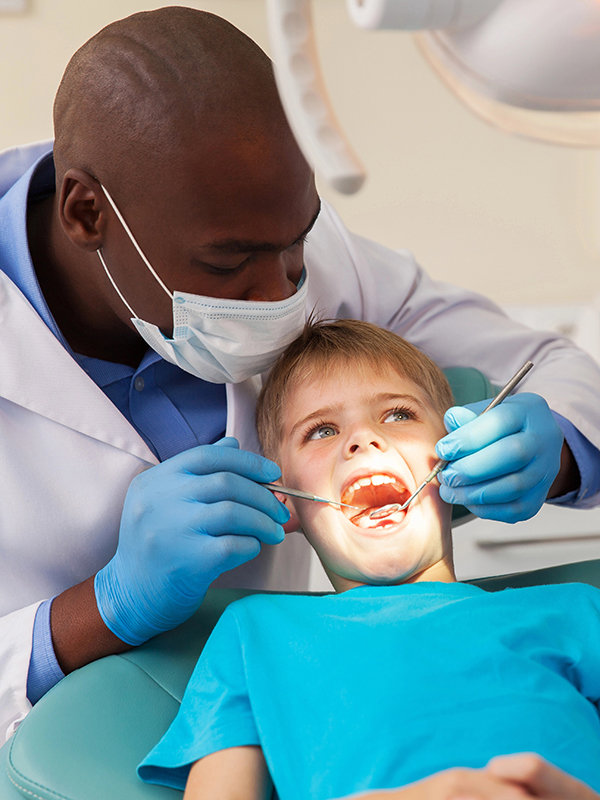
- Healthcare facilities: Disinfecting patient rooms, waiting areas and common spaces to reduce the risk of infections.
- Educational institutions: Creating safer classrooms, cafeterias and dormitories for students and staff.
- Hospitality venues: Ensuring clean and hygienic conditions in hotels, restaurants and gyms.
By deploying UV CARE 222 products, these spaces can be continuously disinfected without compromising the health and safety of occupants.
Tackling hard-to-clean areas
Far-UVC light is particularly effective in combating pathogens in areas with poor ventilation or high touch surfaces. Our technology addresses challenges in:
- Bathrooms: Eliminating germs on surfaces and in the air, reducing the risk of contamination.
- Elevators: Providing continuous disinfection to prevent the spread of viruses and bacteria.
- Locker rooms: Creating a hygienic environment for athletes and gym-goers.
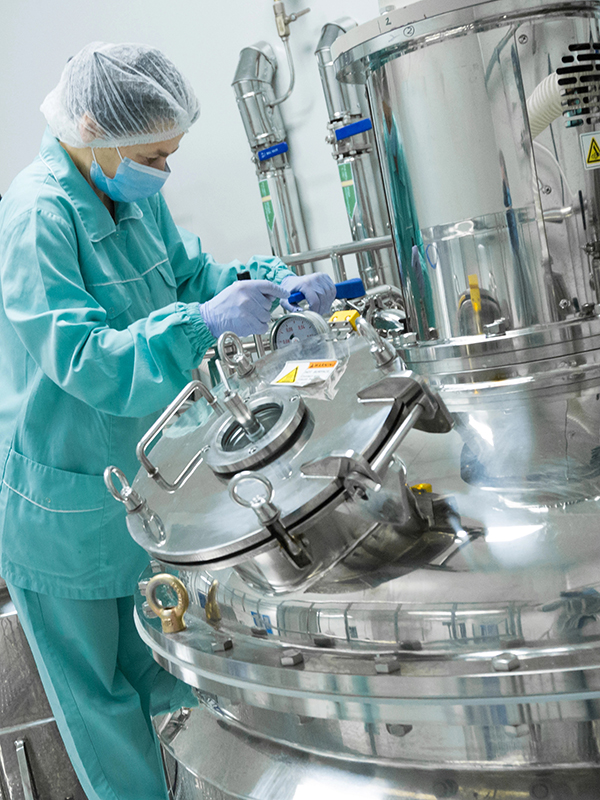
- Food preparation areas: Ensuring the safety of food handling surfaces and reducing the risk of contamination.
UV CARE 222 offers a reliable and efficient solution for maintaining cleanliness and preventing the spread of germs in these challenging environments.
UVC & Far-UVC Light
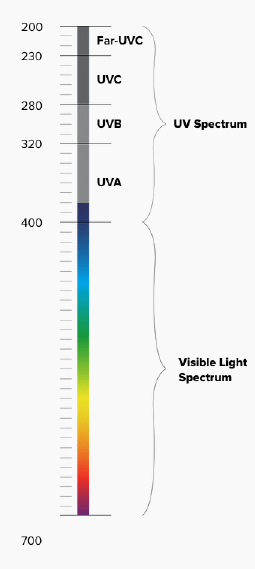
Ultraviolet (UV) light ranges between 400-100nm in wavelength. While most people are familiar with UVA and UVB due to their association with the sun’s rays, UVC has rapidly grown in awareness since the pandemic due to its incredible ability to inactivate pathogens rapidly and effectively.
UV light damages the structure of DNA that can, at high enough levels, stop cells, bacteria, and viruses from reproducing.
UVC is most commonly used commercially for food and water sterilization, as well as sterilization of air, tools, and equipment for hospitals.
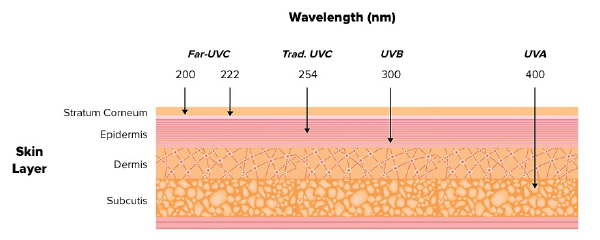
Commercial UVC can be broken down into traditional UVC (Low Pressure Mercury and LEDs emitting 230-280nm) and Far-UVC (Krypton Chlorine excimer emitting 222nm). While both UVC and Far-UVC are effective against gram negative, gram positive, and antibiotic resistant bacteria, as well as both enveloped and non-enveloped viruses, they differ in the risk to humans. Traditional UVC penetrates into skin and causes skin irritations, limiting its use to unoccupied rooms, contained situations, or upper room germicidal systems where people are not directly exposed to it. Far-UVC has a shorter penetration depth, allowing for wider use.
Far-UVC Light
Safety
The safety of UV light on skin is dependent on the wavelength and light intensity. The more UV light you receive, the greater the risk of skin damage. But this risk is proportional to the wavelength of the UV light as well. The shorter the wavelength, the safer for human skin. This is because shorter wavelengths do not travel through skin as well as long wavelengths.
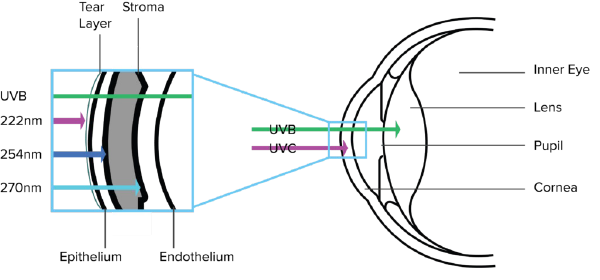
Far-UVC, the shortest wavelength we’ve discussed, is unable to penetrate the tear layer of our eyes or the dead skin layer, also called the Stratum Corneum. Far-UVC is scattered or absorbed by these peripheral layers and shield the living tissue below, rendering it safe for human eyes and skin. This difference allows for greater ability to clean occupied spaces.
Today, most UV cleaning systems are contained in air ducts, within boxes, used only in unoccupied spaces, or are shined at ceilings so that the higher, cheaper to produce wavelengths can be used. Small spaces such as bathrooms and elevators are difficult to clean due to lack of airflow, renewing pathogen sources, and concerning surface contamination. Human safe Far-UVC is the ideal solution for these difficult, insufficiently ventilated, high traffic spaces.
Far-UVC Light
Effectiveness
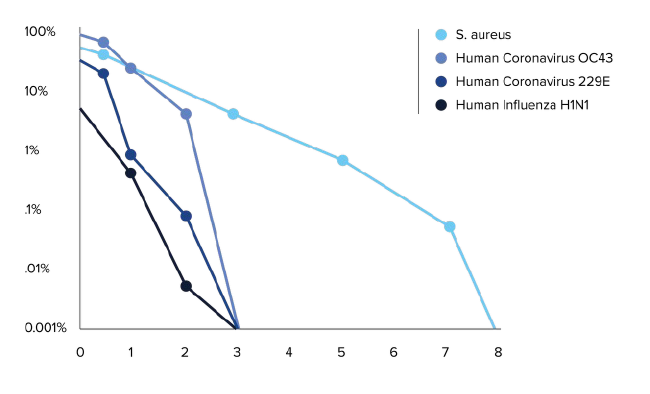
Unlike traditional cleaners which depend on causing oxidative stress or damaging membranes leaving them ineffective against some viruses and spores, UV light targets the DNA or RNA of cells and viruses to provide a cleaning effect. Because of this, UV light is effective against bacteria, viruses, fungi, protists, algae, and spores. With UV light, pathogens can be reduced by 99.9% repeatedly in a time and cost effective manner [2].
Learn more about published 222nm efficiency against various pathogens here.
Independent Visium testing demonstrate up to 99.9% effectiveness against a broad range of pathogens. See the data here.
Example of Far-UVC on Microbes
Surviving Fraction
Why We Need
Far-UVC Light
Far-UVC light is able to kill bacteria, viruses, moulds, and spores in the same fashion as traditional UVGI. Far-UVC and traditional UVC cleans all the air exposed to the light, dramatically increasing the air cleanliness of our shared spaces. The greatest advantage of Far-UVC is the ability to shine its light downwards in occupied rooms safely.
Numerous research studies show Far-UVC is as effective at inactivating infectious contaminants as traditional UVC, without the health risk to skin and eyes. By introducing UV Care222 to any existing mitigation process, indoor air can be cleaned more rapidly and efficiently without any harm to the occupants.
Citations
1) Far UVC Efficacy Example – Eadie, E., Hiwar, W., Fletcher, L. et al. Far-UVC (222 nm) efficiently inactivates an airborne pathogen in a room-sized chamber. Sci Rep 12, 4373 (2022). https://doi.org/10.1038/s41598-022-08462-
2) Far UVC Efficacy and Safety- Hessling, M., Haag, R., Sieber, N., and Vatter, P. (2021). The impact of far-UVC radiation (200-230 nm) on pathogens, cells, skin, and eyes – a collection and analysis of a hundred years of data. GMS hygiene and infection control, 16, Doc07. https://doi.org/10.3205/dgkh000378


Registered Office: Unit 6, Old School House, School Street, Pontyclun, CF72 9FF, Wales, United Kingdom
Operational Sites: Wales, West Country & East Anglia
Company Number: 13791266
D-U-N-S Number: 228512382
VAT Number: GB 448730277